Course Title: Bioinformatics (Complete Hands-on Training)
Course Duration: 1 to 3 Months
Course Content Overview
- Fundamentals of Bioinformatics
- Introduction to bioinformatics and its applications in biological research.
- Sequence alignment and sequence analysis.
- BLAST and scoring matrices.
- Basic phylogenetic analysis and interpretation.
- Linux & Command Line Basics
- Introduction to Linux operating systems and command-line interfaces.
- File and directory navigation and management.
- Basic shell commands and scripting.
- Remote server access and working with computational resources.
- Python for Bioinformatics
- Python fundamentals: data types, loops, functions, and basic programming.
- Introduction to Biopython.
- Biological sequence and file parsing.
- Data handling using Pandas.
- R for Bioinformatics
- Fundamentals of R programming.
- Data visualization using ggplot2.
- Introduction to Bioconductor.
- Statistical testing and interpretation of biological data.
- Biological Databases
- Introduction to major biological databases.
- Data retrieval from NCBI, UniProt, PDB, Ensembl, KEGG, and STRING.
- Searching, querying, and downloading biological datasets.
- Understanding different types of biological information available in databases.
- DNA Sequencing Technologies
- Introduction to Sanger sequencing.
- Overview of Next-Generation Sequencing (NGS).
- Introduction to long-read sequencing technologies such as PacBio and Nanopore.
- Understanding the basic sequencing workflow.
- Basics of NGS Data Analysis
- Understanding FASTQ files and sequencing data.
- Quality control using FastQC.
- Sequence trimming and preprocessing.
- Read mapping and alignment.
- Introduction to SAM/BAM files.
- Basic variant calling workflow.
- Structural Biology
- Introduction to protein structure and structural bioinformatics.
- Exploring structures using the Protein Data Bank (PDB).
- Protein structure visualization and analysis.
- Understanding structure-function relationships.
- Molecular Docking
- Fundamentals of molecular docking.
- Ligand-receptor interaction analysis.
- Molecular docking using AutoDock Vina and GNINA.
- Understanding and interpreting docking scores.
- Molecular Dynamics Simulation
- Introduction to molecular dynamics simulations.
- Basics of GROMACS/AMBER.
- Understanding force fields.
- Basic trajectory analysis and interpretation.
- ADMET & Drug-Likeness Evaluation
- Introduction to drug-likeness assessment.
- Lipinski's Rule of Five.
- ADMET prediction using pkCSM and SwissADME.
- Basic toxicity prediction and interpretation.
- Protein-Protein Interaction (PPI) Analysis
- Introduction to protein-protein interaction networks.
- PPI analysis using STRING.
- Network visualization using Cytoscape.
- Identification and analysis of hub genes/proteins.
- Genomics
- Introduction to genome assembly.
- Genome annotation.
- Comparative genomics.
- Variant analysis and interpretation.
- Transcriptomics
- Introduction to transcriptomic data analysis.
- RNA-seq workflow.
- Differential gene expression analysis.
- Pathway analysis and biological interpretation.
- Proteomics
- Introduction to computational proteomics.
- Protein identification.
- Mass spectrometry data analysis.
- Quantitative proteomics and data interpretation.
- Metabolomics
- Introduction to metabolomic analysis.
- Metabolite profiling.
- LC-MS and GC-MS data analysis.
- Metabolic pathway mapping.
- Metagenomics
- Introduction to metagenomic analysis.
- 16S rRNA-based analysis.
- Shotgun metagenomics.
- Taxonomic profiling and microbial diversity analysis.
Key Features
- Extensive hands-on training in bioinformatics tools and databases.
- Practical exposure to Linux, Python, R, NGS, structural bioinformatics, and multi-omics analysis.
- Training in computational approaches used in genomics, drug discovery, and biological research.
- Exposure to real biological datasets and computational analysis workflows.
- Research-oriented learning suitable for academic and industry applications.
Assessment and Certification
- Practical and theoretical assessments to evaluate knowledge and computational skills.
- Hands-on evaluation through bioinformatics analysis workflows.
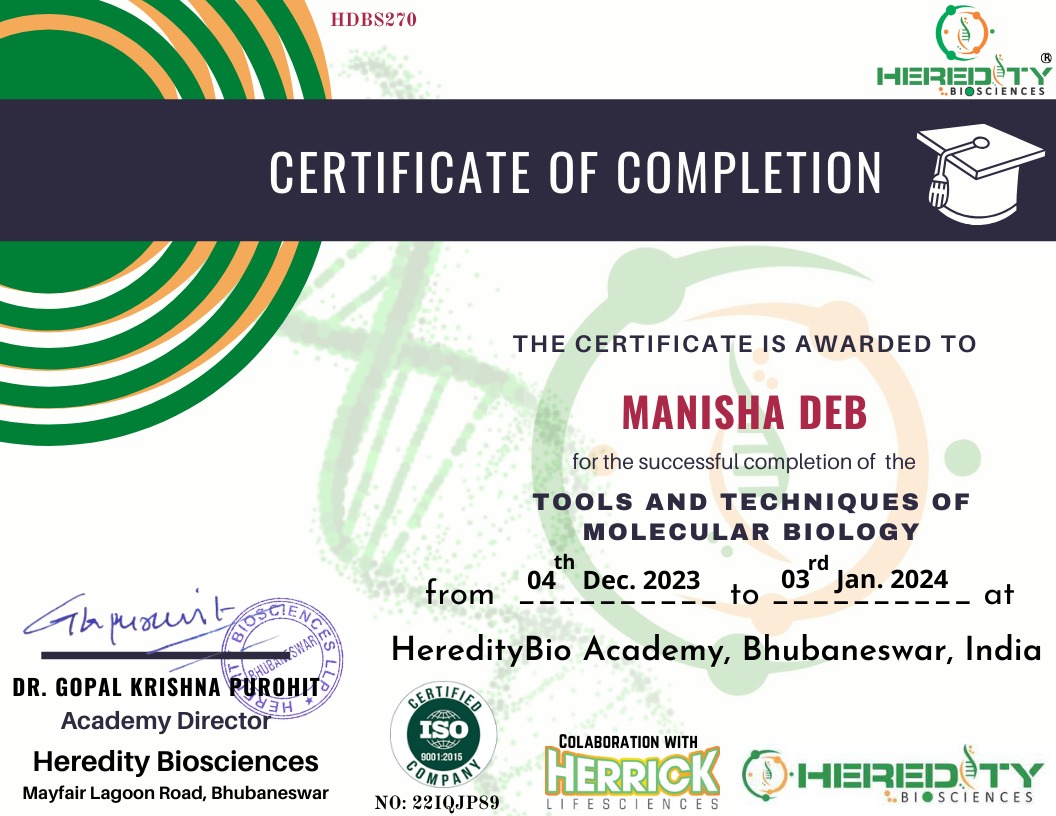
- Certificate of completion awarded upon successful completion of the program.
Q1: What is the duration of the Bioinformatics training program?
A: The Bioinformatics training program is available for 1 to 3 months, depending on the selected training format and learning requirements.
Q2: Do I need a coding background to join the Bioinformatics program?
A: No. The program starts with the basics of Python, R, and Linux, making it suitable for students from different academic backgrounds.
Q3: What educational background is required?
A: Students with a background in Biotechnology, Bioinformatics, Microbiology, Life Sciences, Biochemistry, Pharmacy, or related fields can benefit from the program. Basic knowledge of molecular biology is helpful.
Q4: What topics will be covered during the training?
A: The training covers Bioinformatics fundamentals, Linux, Python, R, biological databases, NGS analysis, structural biology, molecular docking, molecular dynamics, ADMET analysis, PPI analysis, genomics, transcriptomics, proteomics, metabolomics, and metagenomics.
Q5: Will I get hands-on experience during the program?
A: Yes. The program focuses on practical, hands-on learning using bioinformatics tools, databases, software, and biological datasets.
Q6: What tools and software will I learn?
A: Training includes tools and platforms such as NCBI, UniProt, PDB, Ensembl, KEGG, STRING, BLAST, Python, Biopython, R, Bioconductor, FastQC, Cytoscape, AutoDock Vina, GROMACS, and SwissADME.
Q7: Will I work with real biological data?
A: Yes. The training includes practical analysis of sequence, genomic, transcriptomic, proteomic, metabolomic, and metagenomic datasets.
Q8: Is molecular docking and drug discovery included?
A: Yes. The program includes molecular docking, ligand-receptor interaction analysis, molecular dynamics, drug-likeness, ADMET evaluation, and toxicity prediction.
Q9: Can I learn Bioinformatics if I have no programming experience?
A: Yes. Programming concepts are introduced from the basics, followed by their application to biological data analysis.
Q10: Will I receive a certificate after completing the training?
A: Yes. Participants who successfully complete the program will receive a Certificate of Completion.
Q11: What computer requirements are recommended for the training?
A: A laptop with sufficient RAM and storage for installing bioinformatics software and handling biological datasets is recommended. Specific requirements may vary depending on the tools and analysis being performed.
Q12: How can I apply for the Bioinformatics training program?
A: Interested candidates can contact Heredity Biosciences for registration details and further information.
For further inquiries or to learn more about the Bioinformatics training program, please contact us.

.png)